
Quick Answer: Nutrient Survival wins on nutrition (40 essential nutrients, lower sodium, Omega-3s) and value per kit, while Mountain House wins on taste, meal variety, and a longer 30-year shelf life. Choose Nutrient Survival for health-focused long-term storage; Mountain House for taste and camping use.
When disaster strikes-a prolonged power outage, hurricane, wildfire evacuation-what you’ve stored determines whether your family thrives or just survives. Mountain House and Nutrient Survival are the two brands most emergency planners stack against each other, and for good reason: they sit at opposite ends of the taste-versus-nutrition spectrum.
Mountain House has been the gold standard in freeze-dried food for over 50 years, trusted by military units and backpackers alike. Nutrient Survival launched in 2020 with a hard pivot: a former Army Ranger-designed formulation meeting or exceeding Special Operations Forces nutrition standards as defined in DoD publications. Both are genuinely excellent. Neither is perfect for everyone.
This comparison breaks down what actually matters for emergency preparedness-nutrition density, shelf life, taste, value, and which kit belongs in your home.
Table of Contents
Key Takeaways
- Nutrient Survival delivers 40 essential nutrients per serving and significantly lower sodium; Mountain House offers superior taste and a 30-year taste guarantee.
- Nutrient Survival’s 30-day kit costs ~$500-$550 for 220-245 servings; Mountain House’s 30-day kit runs ~$900+ for 180 servings-a major price gap.
- Mountain House uses real meat in protein-forward meals; Nutrient Survival adds protein via whey and pea protein without meat in most entrees.
- For long-term emergency storage at home, Nutrient Survival offers better nutritional completeness; for camping, hiking, and short-term kits, Mountain House remains the taste leader.
- Stock your family’s 30-day or 14-day emergency supply now with Nutrient Survival kits available on Batten.
Nutrient Survival: Nutrition-First Emergency Food
Nutrient Survival entered the market with a clear mission: stop treating emergency food as “just calories” and start treating it as complete nutrition. Their patented formula was built to the requirements of Special Operations Forces and delivers 6x more nutrients per calorie than most competing brands.
Nutrient Survival at a Glance
- Price (30-Day Kit): ~$500-$550 (220-245 servings, as of February 2026)
- Shelf Life: 25 years (#10 cans); 15 years (pouch kits)
- Nutrients Per Serving: Up to 40 essential nutrients (14 vitamins, 14 minerals, 9 amino acids, fiber, Omega-3 & 6)
- Protein Per Day: 77-85g (30-day kit)
- Sodium: Significantly lower than competitors-Nutrient Survival mac & cheese contains roughly 1/3 the sodium of Mountain House mac & cheese
- Best For: Long-term home storage, health-conscious families, post-disaster sustained nutrition
- Buy: 30 Day Emergency Food Kit – Nutrient Survival – 220 Servings | 14 Day Emergency Food Kit – Nutrient Survival – 110 Servings
What sets Nutrient Survival apart nutritionally is that they engineer meals from the ground up for micronutrient density-they don’t just freeze-dry a recipe and hope for the best. Research from the NIH confirms that Omega-3 fatty acids modulate inflammatory pathways and enhance immune function-a meaningful benefit for anyone spending 2-4 weeks eating exclusively from emergency stores in a high-stress scenario. Most competing emergency food brands include no Omega-3s at all.

Freeze-drying as a preservation method retains up to 97% of original nutritional content, making it the gold standard for locking in vitamins and minerals compared to canning (40-60% retention) or dehydration. Both Nutrient Survival and Mountain House benefit from this, but Nutrient Survival’s nutrient-infused formulation starts with a higher baseline.
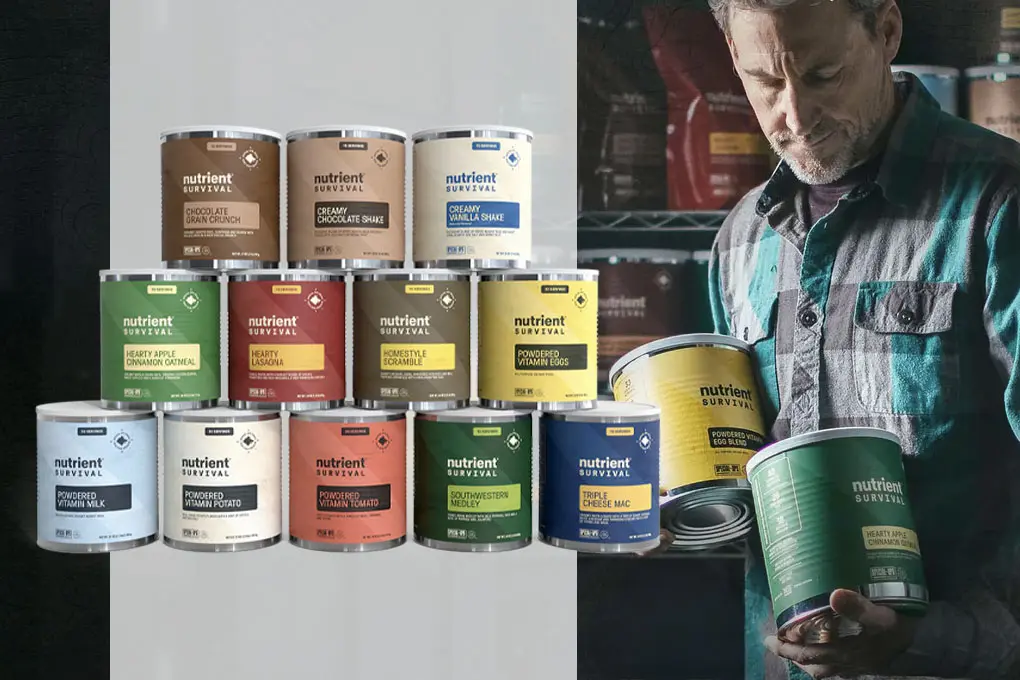
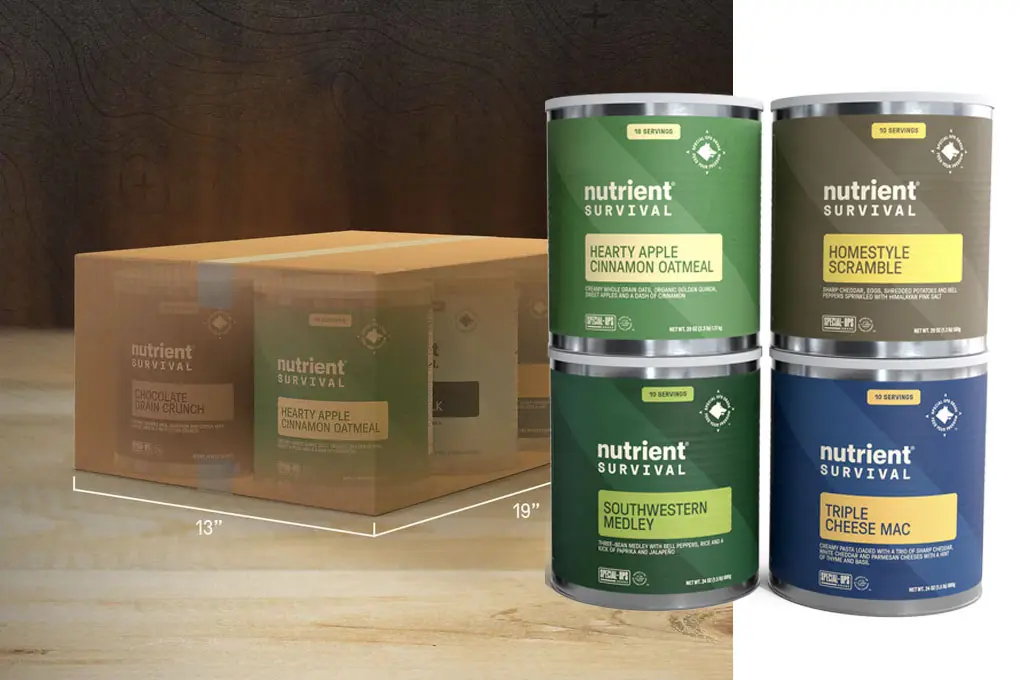
Their product line centers on #10 cans (25-year shelf life) covering breakfasts, entrees, shakes, and pantry staples like powdered eggs, powdered milk, and powdered butter-each fortified with essential nutrients. Single-serve pouches work well in go-bags, though shelf life drops to 15 years. Meal cookies and protein cereals make this the most picky-eater-friendly option in the emergency food category.
The honest limitation: Nutrient Survival’s entrees don’t contain actual meat-protein comes from whey powder and pea protein. Meal variety in kits is narrower than Mountain House, typically anchored around 3-6 main entrees. Flavor fatigue over a 30-day scenario is a real concern. Check our best tasting survival food guide for tips on building variety into your supply.

Pros and Cons
Pros:
- Up to 40 essential nutrients per serving-the most complete micronutrient profile in emergency food
- Significantly lower sodium than Mountain House and most competitors
- Omega-3 fatty acids included, supporting cognitive function and stress response (NIH, PubMed)
- Competitive pricing-30-day kit costs $200+ less than comparable Mountain House kit
- 25-year shelf life on #10 cans; US-made in small batches with in-house production
- Satisfaction guarantee with returns accepted; phone customer support available
Cons:
- No real meat in most entrees (protein from whey/pea protein supplements)
- Narrower meal variety in standard kits vs. Mountain House
- Single-serve pouch shelf life is 15 years, not 25
- Meal bars have only 18-month shelf life (syrup content)
- Less widely available in physical retail stores
Mountain House: Taste-Forward Emergency Food
Mountain House has a 50+ year track record for one simple reason: the food genuinely tastes good. While competitors were busy packing starchy paste into foil pouches, Mountain House was refining recipes with real beef in their stroganoff, real chicken in their fettuccine alfredo, and real granola in their blueberry breakfast. That commitment to flavor and real ingredients-no TVP or artificial flavors-built their dominance in the camping and military supply markets before the home emergency prep boom.
Mountain House at a Glance
- Price (30-Day Kit): ~$900+ (180 servings, as of February 2026)
- Shelf Life: 30 years (industry-leading, backed by Taste Guarantee)
- Nutrients Per Serving: Standard freeze-dried profile (~15-20 key nutrients)
- Calories Per Day: ~1,732 (30-day kit)
- Sodium: Higher than competitors-a known concern for multi-week consumption (high-sodium diets increase blood pressure and put added strain on kidneys)
- Best For: Camping, bug-out bags, short-term emergency kits, taste-sensitive household
Mountain House’s preparation simplicity is a genuine strength. Pour boiling water directly into the pouch, stir, wait 9 minutes, eat from the pouch-no pot, no pan, no cleanup. For 72-hour kits and camping scenarios, this is the gold standard experience. Their 30-year taste guarantee-the longest in the industry-offers real peace of mind for long-term storage.
Post-2020, Mountain House reduced serving sizes on some products-a frustration noted by longtime buyers on forums and in independent reviews. Several entrees that previously yielded 10 servings per #10 can now yield 8, with reduced protein content in some kits. This is worth noting when planning caloric sufficiency for extended emergencies.

The honest limitation: Mountain House costs significantly more per serving than Nutrient Survival for comparable kit sizes. Their nutritional profile is solid but not exceptional-closer to 15-20 key nutrients per serving rather than the full-spectrum 40-nutrient profile Nutrient Survival achieves.
Sodium levels are notably high across most entrees-the American Heart Association recommends no more than 2,300mg of sodium per day, and research shows high-sodium diets increase the risk of hypertension, kidney stress, and dehydration-related effects during prolonged stress.
Pros and Cons
Pros:
- Industry-leading taste-real meat, real ingredients, no TVP or artificial flavors
- 30-year taste guarantee (longest proven shelf life on the market)
- Widest meal variety-10+ different entrees in the 30-day kit alone
- Pouch-in-pouch preparation: no cookware needed, eat directly from the bag
- Over 50 years of manufacturing refinement; trusted by US military
- Available at major retailers (REI, Costco, Amazon, Home Depot) for easy restocking
Cons:
- Significantly more expensive-30-day kit runs $200-$300+ more than Nutrient Survival
- Higher sodium across most entrees-problematic for multi-week emergency consumption given CDC sodium guidelines
- Fewer micronutrients per serving vs. Nutrient Survival’s 40-nutrient patented formula
- No Omega-3 supplementation; no nutrient fortification beyond standard freeze-drying
- Post-2020 recipe changes reduced serving sizes and protein content in some products
- No returns accepted on food items (unless defective or damaged)
Value Comparison: Cost Per Serving
| Kit | Servings | Total Price | Price/Serving | Calories/Day | Protein/Day |
| Nutrient Survival 14-Day Kit | 110 | ~$270-$315 | ~$2.45-$2.86 | ~1,290 | ~75g |
| Nutrient Survival 30-Day Kit | 220-245 | ~$500-$550 | ~$2.25-$2.50 | ~1,290-1,400 | 77-85g |
| Mountain House 30-Day Kit | 180 | ~$900+ | ~$5.00+ | ~1,732 | Varies by meal |
| Mountain House 3-Day Kit | 18 | ~$45-$55 | ~$2.50-$3.00 | ~1,706 | Varies |
Prices as of February 2026. Kit calorie counts are per-person-per-day estimates.
Nutrient Survival’s pricing advantage is most visible in the 30-day comparison-buyers pay roughly half as much for a comparable duration supply. The trade-off: Mountain House’s 30-day kit delivers more calories per day (~1,732 vs ~1,290-1,400 for Nutrient Survival). For families with higher caloric needs-active adults, teenagers, physically demanding evacuation scenarios-Mountain House’s caloric density is a genuine advantage worth the premium.

For budget-conscious families building their first 30-day emergency food supply, Nutrient Survival is the clearer value winner. For short-duration kits (72-hour bags, camping supplies), Mountain House pouches offer per-serving pricing closer to parity while delivering a better eating experience.
Which Brand Is Right for Your Emergency Plan?
The answer depends on your preparedness scenario. FEMA recommends maintaining at least a 72-hour to two-week food supply, with many emergency managers suggesting a month or more for disaster-prone regions.
Choose Nutrient Survival if you:
- Are building a 14-day, 30-day, or longer home emergency supply
- Have household members with health conditions requiring complete micronutrient intake
- Want to reduce sodium intake during a high-stress emergency scenario (supported by AHA sodium guidelines)
- Are prioritizing budget efficiency across a multi-month supply build
- Have picky eaters who prefer cereal, oatmeal, and pasta over meat-forward entrees
Choose Mountain House if you:
- Need lightweight, no-cookware-required meals for a bug-out bag or go-bag
- Are building a 72-hour or 5-day short-duration kit
- Prioritize taste and meal variety over micronutrient density
- Are supplementing an existing food storage with camping-ready pouches
- Have family members who will only eat “real food” during stress
For families building a complete home emergency kit, the most resilient approach combines both: Nutrient Survival 30-day or 14-day kits anchoring your home pantry, Mountain House pouches ready to grab for evacuation bags. This covers both the stay-in-place extended emergency and the rapid-departure scenario.
The USDA’s food safety guidelines and CDC emergency preparedness resources both emphasize that maintaining a pre-stocked food supply-not relying on emergency shelters alone-significantly improves family outcomes following disasters. For wider preparedness planning, our family emergency communication plan guide and food shortage preparation guide cover the broader picture.
Getting Your Emergency Food Strategy Right
Building your emergency food supply isn’t a one-and-done purchase. FEMA recommends reviewing and rotating emergency food every 6-12 months and checking expiration dates as part of a regular preparedness audit. For families with specific food storage challenges-like keeping food viable in your vehicle-building nutrition into the plan rather than just calories makes the difference between functioning well during a crisis and struggling with malnutrition fatigue.
A few final practical notes:
- Both brands require hot water for optimal preparation. Store a reliable backup stove or heating method for your emergency kit
- Both perform best stored below 75°F-garage and attic storage can reduce shelf life significantly in warm climates
- Neither brand alone covers caloric needs for physically active adults during a labor-intensive emergency. Consider supplementing with calorie-dense additions (nut butters, olive oil, hard candy)
- Regularly cooking with and eating your emergency stores-food rotation-ensures you know what you actually like before a crisis forces the decision
Ready to build your family’s emergency food supply? Batten carries Nutrient Survival 30-day kits (220 servings) and 14-day kits (110 servings) with 25-year shelf life-delivered to your door with free shipping on qualifying orders.
Frequently Asked Questions
Is Nutrient Survival Better Than Mountain House for Long-Term Storage?
For nutrition-focused long-term storage, Nutrient Survival is the stronger choice. Its 40 essential nutrients per serving, lower sodium, and Omega-3 content are superior for extended emergency use. Mountain House edges ahead on shelf life (30 vs. 25 years) and taste variety, but costs significantly more per serving for comparable kit durations.
Which Survival Food Has Better Nutrition: Nutrient Survival or Mountain House?
Nutrient Survival delivers significantly better micronutrient density-up to 40 essential nutrients per serving vs. roughly 15-20 in Mountain House meals. Nutrient Survival includes Omega-3 fatty acids and amino acids absent from Mountain House products. Mountain House offers more calories per serving and uses real meat in entrees, contributing to its protein profile.
Does Nutrient Survival Taste Good Compared to Mountain House?
Most independent testers rate Mountain House higher on taste, particularly for meat-based entrees. Nutrient Survival’s breakfasts and cereals receive strong taste reviews; shakes and meal bars are more mixed. After extended tasting, many testers find Nutrient Survival competitive for breakfast meals but rate Mountain House higher for dinner entrees.
What Is the Shelf Life of Nutrient Survival vs Mountain House?
Mountain House holds a 30-year taste guarantee-the longest in the industry. Nutrient Survival #10 cans carry a 25-year shelf life; single-serve pouches are rated at 15 years. Meal bars from Nutrient Survival have only an 18-month shelf life due to syrup content.
Is Nutrient Survival or Mountain House Better for a 72-Hour Kit?
Mountain House is the better choice for 72-hour kits. Pouches require no cookware, preparation is fast, and variety within a 3-day kit is excellent. The higher per-serving cost matters less for a short-duration kit, and Mountain House’s taste advantage improves compliance during short, high-stress events.
Which Emergency Food Brand Is Healthiest for Families?
Nutrient Survival is the healthier long-term option. It’s designed to meet or exceed military Special Operations nutrition standards with a patented formula covering all 40 essential nutrients. Lower sodium levels are particularly important during extended emergency use, given that high-sodium diets increase dehydration risk and strain kidneys. The American Heart Association’s sodium guidelines recommend no more than 2,300mg per day-a threshold many Mountain House entrees approach individually.
Can You Live on Mountain House Meals Alone During an Emergency?
Mountain House provides sufficient calories (approximately 1,732/day in the 30-day kit), but the nutritional profile is incomplete for extended solo consumption. Sodium levels are high and micronutrient coverage is limited to what survives the freeze-drying process. For stays under 2 weeks, Mountain House is adequate. For longer scenarios, supplementing with a full-spectrum vitamin or pairing with Nutrient Survival’s fortified meals is advisable.
What Is the Cost Per Serving for Nutrient Survival vs Mountain House?
Nutrient Survival runs approximately $2.25-$2.86 per serving in kit form (as of February 2026). Mountain House costs approximately $5.00+ per serving in 30-day kit form-making Mountain House roughly 2x the cost per serving. Short-duration Mountain House kits (3-day) narrow the gap to around $2.50-$3.00 per serving.
Does Mountain House Use Real Meat in Its Meals?
Yes. Mountain House uses real precooked beef, chicken, and other proteins in their entrees-a key differentiator. Beef Stroganoff contains actual beef pieces; Fettuccine Alfredo contains real chicken. Nutrient Survival entrees are meatless, with protein supplied by whey powder and pea protein. For preppers prioritizing whole-food protein sources, Mountain House holds a genuine advantage.
Which Emergency Food Is Best for Preppers With Budget Constraints?
Nutrient Survival offers better long-term value for budget-conscious preppers. At roughly half the cost per serving of Mountain House for 30-day kit comparisons, Nutrient Survival lets you stock twice as many servings for the same investment. FEMA recommends a minimum 2-week food supply; at Mountain House pricing, that investment is significantly higher for comparable coverage.
Sources
- “Build a Kit,” 2024, FEMA/Ready.gov, https://www.ready.gov/kit
- “Food Safety,” 2024, USDA, https://www.usda.gov/topics/food-safety
- “Sodium and Your Health,” 2024, American Heart Association, https://www.heart.org/en/healthy-living/healthy-eating/eat-smart/sodium/how-much-sodium-should-i-eat-per-day
- “The impact of excessive salt intake on human health,” 2022, PubMed/National Library of Medicine, https://pubmed.ncbi.nlm.nih.gov/35058650/
- “Effects of Omega-3 Fatty Acids on Immune Cells,” 2019, PubMed/NIH, https://pubmed.ncbi.nlm.nih.gov/31614433/
- “Freeze-Drying of Plant-Based Foods,” 2020, PMC/NIH, https://pmc.ncbi.nlm.nih.gov/articles/PMC7022747/
- “Nutrition,” Nutrient Survival, https://nutrientsurvival.com/pages/nutrition
- “30-Day Emergency Food Supply Kit,” Mountain House, https://mountainhouse.com/products/30-day-emergency-food-supply-kit
- “Nutrient Survival Review,” 2024, Primal Survivor, https://www.primalsurvivor.net/nutrient-survival-review/
- “5 Best Emergency Food Supply Companies,” May 2025, TruePrepper, https://trueprepper.com/emergency-food-supplier/