
Quick Answer: Stored emergency water remains safe for 6 months in plastic containers when using municipal tap water, or up to 5 years with water preserver treatment in food-grade HDPE containers stored at 50-70°F away from sunlight.
FEMA says 6 months. Preppers say 5 years. Forums say “it depends.” They’re all right – here’s why.
The CDC recommends replacing stored water every 6 months, yet commercial water bottles have no expiration dates. A 2024 analysis found that 73% of American households lack adequate emergency water supplies, and those who do store water often maintain it incorrectly – creating bacterial growth risks.
Water itself doesn’t expire, but storage conditions determine when it becomes unsafe or undrinkable. Understanding shelf life requires examining four critical factors: container type, chlorine level, storage temperature, and light exposure.
Table of Contents
- Key Takeaways
- The Four Factors That Determine Water Shelf Life
- Testing Your Stored Water: Three Simple Safety Checks
- The Simple Water Rotation System
- Extending Water Storage to Five Years
- Emergency Water Sources When Storage Runs Out
- Building Your Complete Water Strategy
- Storing Water for the Long Run
- Frequently Asked Questions
- Sources
Key Takeaways
- Emergency water storage shelf life ranges from 6 months (untreated plastic) to 5+ years (treated food-grade containers) depending on container type, chlorine levels, temperature, and light exposure.
- BPA leaching from plastic containers accelerates after 12-18 months, particularly above 70°F, making HDPE #2 containers safer than polycarbonate for long-term storage.
- Water preserver concentrate extends storage to 5 years by maintaining residual chlorine that prevents bacterial regrowth, eliminating 6-month rotation cycles.
- Three simple tests identify compromised water: chlorine smell should remain present, taste should not be stale or metallic, and visual inspection should show zero cloudiness.
- Build emergency water supply with Batten’s water storage collection featuring AquaBrick containers, purification tablets, and filtration systems designed for reliable long-term storage.
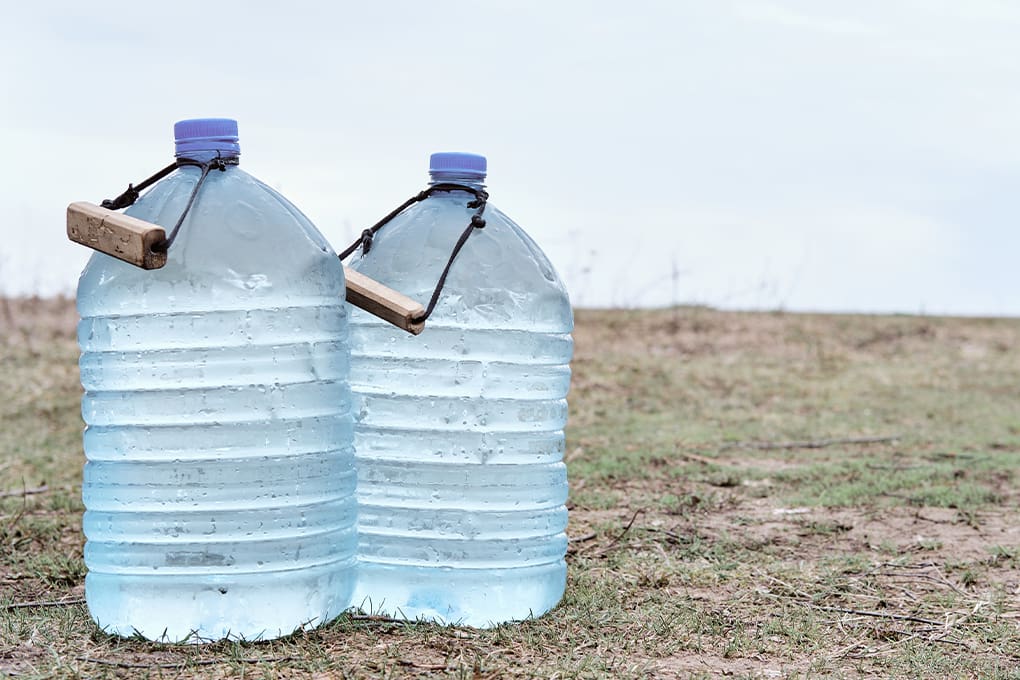
The Four Factors That Determine Water Shelf Life
Water shelf life depends on a small set of controllable factors that determine how long stored water stays safe, clean, and ready for emergency use.
1. Container Type Determines Storage Duration
Container material directly impacts water safety and taste degradation timeline.
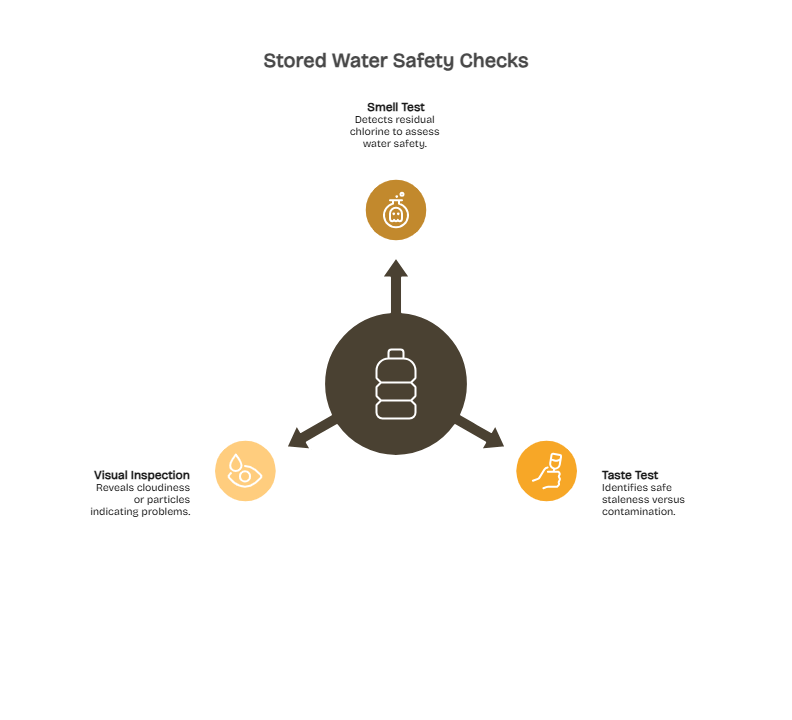
- High-Density Polyethylene (HDPE #2) ranks as the gold standard for emergency water storage. The Journal of Water and Health confirms HDPE containers show minimal chemical migration for 12-18 months under ideal conditions.
- Polyethylene Terephthalate (PET #1) bottles function adequately for short-term storage but degrade faster. Research shows PET bottles stored above 70°F showed 40% faster degradation rates.
- Polycarbonate (PC #7) containers present significant BPA leaching concerns. Studies measuring BPA concentrations in polycarbonate bottles found levels exceeding safe thresholds after just 6 months at outdoor temperatures.
| Container Type | Storage Duration | BPA Risk | Cost per Gallon | Best For |
| HDPE #2 | 12-18 months | Low | $0.50-$1.00 | Long-term bulk storage |
| PET #1 | 6-12 months | Minimal | $0.30-$0.60 | Short-term rotation |
| Glass | Indefinite | None | $2.00-$4.00 | Premium small batches |
| Stainless Steel | 10+ years | None | $3.00-$6.00 | Portable emergency kits |
| Polycarbonate #7 | 6 months max | High | $1.00-$2.00 | Avoid for water storage |
2. Chlorine Level Affects Bacteriostatic Protection
Municipal tap water is disinfected with free residual chlorine, typically around 0.2-0.8 mg/L, to suppress microbial contamination during distribution. Studies show that chlorine declines rapidly after storage, dropping by roughly 50-60% within 24 hours depending on temperature, light exposure, and whether the container is sealed.
Filtered water removes chlorine along with contaminants, eliminating disinfectant protection. Water run through activated carbon filters, reverse osmosis systems, or pitcher filters requires immediate treatment before storage. The CDC specifies that filtered water stored without treatment becomes unsafe within 2-4 weeks.
Well water requires treatment before storage. A USGS survey found 23% of private wells tested positive for coliform bacteria – present from source, not introduced during storage.

3. Temperature Controls Degradation Speed
The ideal range of 50-70°F balances bacterial growth prevention and plastic integrity preservation.
Room temperature (65-75°F) represents the practical sweet spot. At these temperatures, properly treated water in HDPE containers maintains safety for 12 months without noticeable taste changes.
Hot storage (80°F+) accelerates every negative factor. Water stored at 80°F showing 3-5 times higher bacterial counts after 6 months compared to 60°F storage.
Vehicle storage creates worst-case scenarios – interior temperatures reach 130-170°F in summer. Water bottles stored in vehicles for 4 weeks at summer temperatures showed BPA levels 79% higher than bottles stored indoors at 70°F.
4. Light Exposure Enables Algae Growth
Complete darkness prevents photosynthetic activity while reducing plastic degradation from UV exposure.
Direct sunlight exposure guarantees algae growth within 2-6 months. Outdoor-stored water barrels in direct sun showed algae growth in 78% of samples after just 90 days.
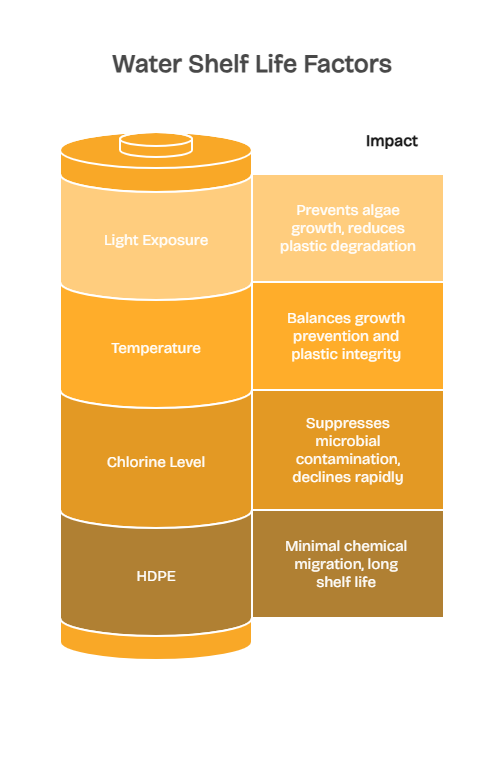
Testing Your Stored Water: Three Simple Safety Checks
Before drinking stored water, a few quick sensory checks can reveal whether it remains safe, stable, and properly protected from contamination.
1. Smell Test: Detecting Residual Chlorine
Remove the container cap and immediately smell the water without pouring. Properly stored treated water should retain a barely-detectable chlorine scent even after 6 months.
Timeline: Month 1-3: Strong chlorine scent. Month 4-6: Faint but detectable. Month 7-9: Undetectable to most people. Month 10+: Complete absence, protection lost.
2. Taste Test: Safe Staleness vs. Contamination
Pour 1-2 tablespoons into a clean glass. Take a small sip, roll water around your mouth for 5-10 seconds, then spit out.
Safe staleness indicators: Flat taste, slight plasticky note, faint metallic undertone, or absence of chlorine taste.
Danger signals: Bitter or sour taste, sweet or rotten flavor, musty or earthy taste, or chemical taste resembling solvents.

3. Visual Inspection: Cloudiness Indicates Problems
Hold the container against a white background in bright light. Shine a flashlight through water in darkness to reveal suspended particles invisible in ambient light.
Acceptable appearance: Completely clear, no color tint, no floating matter, no sediment on bottom.
Concerning signs: Any cloudiness, visible floating particles, greenish or brownish tint, white or gray sediment, or pink/black spots on walls.
For water filtration options, check out the best GRAYL alternatives right here.
The Simple Water Rotation System
A simple rotation system keeps stored water fresh, safe, and easy to manage without guesswork or wasted effort.
Label with Fill Date and Treatment Type
Use permanent markers on container sides: “Filled: 2/3/26 | Treated: Water Preserver | Replace: 2/3/31”
FIFO Method: First In, First Out
Position newest containers at back or bottom of storage areas. Create designated “use next” zones for containers approaching replacement dates.
Six-Month Replacement for Untreated Water
Tie rotation to recurring holidays. “Replace water on Memorial Day and Thanksgiving” creates habitual patterns.
| Storage Method | Rotation Frequency | Shelf Life | Labor Required | Best For |
| Untreated tap water | Every 6 months | 6 months | High | Active rotators |
| Bleach-treated | Every 9-12 months | 9-12 months | Medium | Budget-conscious |
| Water preserver | Every 5 years | 5 years | Minimal | Set-and-forget |
| Commercial bottled | Check date/none | Indefinite sealed | None | Convenience |
Twelve-Month Storage for Glass/Stainless
Annual replacement aligns with other yearly preparedness tasks like emergency plan reviews and first aid kit restocking.
Extending Water Storage to Five Years
With the right treatment and preparation, stored water can remain safe for years instead of months, reducing maintenance while strengthening long-term emergency readiness.
Water Preserver Concentrate
Water preserver uses stabilized sodium hypochlorite at calibrated concentrations maintaining bactericidal activity for years. Treated water samples showed no bacterial growth after 60 months of sealed storage.
Application: Add 8 drops per gallon to empty containers BEFORE filling. Fill to 1-2 inches below cap, seal tightly, invert several times to wet all surfaces.
Cost analysis: Water Preserver concentrate ($8-12 per 55-gallon treatment) adds $0.15-$0.20 per gallon versus $0.80-$1.50 per gallon for bottled water.

Container Sanitization Process
Step 1 – Washing: Scrub with unscented dish soap and hot water using bottle brushes.
Step 2 – Sanitizing: Mix 1 teaspoon bleach per quart water. Fill container with solution, let stand 30 seconds, rinse briefly.
Step 3 – Air drying: Allow containers to air dry completely before filling. Dry upside down 2-4 hours minimum.
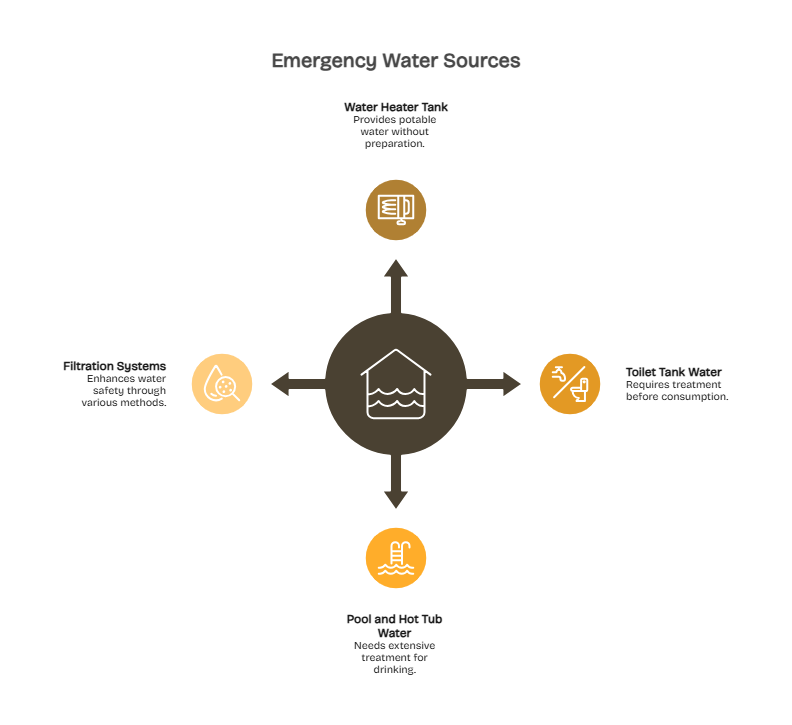
Emergency Water Sources When Storage Runs Out
When stored supplies run dry, several household water sources can provide short-term emergency backup if accessed carefully and treated for safety before use.
Water Heater Tank: 40-80 Gallon Reserve
Every home’s water heater contains 30-80 gallons of potable water requiring no advance preparation.
Access procedure: Turn off power/gas to heater, shut off main water valve, attach garden hose to drain valve, open hot water faucet to break vacuum, open drain valve and collect water.

Toilet Tank Water: Use with Caution
Only use water from tank (upper portion), never from bowl. Only use toilets without chemical cleaners in tank. Treat all toilet tank water – boil 1 minute or add 16 drops bleach per gallon before consumption.
Pool and Hot Tub Treatment
Pool water requires extensive treatment before drinking due to high chlorine (2-4 ppm), stabilizers, algaecides, and pH adjusters designed for swimming, not ingestion.
Treatment: Pour through activated carbon filter like the LifeStraw Personal Water Purifier, then boil 5 minutes.
Non-drinking uses: Pool water excels for toilet flushing, bathing, cleaning without treatment.
Filtration: Beyond Personal Straws
The LifeStraw Personal Water Purifier filters bacteria and protozoa with 99.999% effectiveness but doesn’t remove viruses or dissolved chemicals.

Complete protection: Combine LifeStraw filtration with AQUATABS Water Tablets for dual-barrier approach eliminating biological and chemical threats.
Advanced systems: The Sagan AquaBrick Water Purification System provides multi-stage filtration removing bacteria, protozoa, and chemical contaminants through activated carbon and ceramic elements.
For more water filtration options, read our review of the Epic Water Filter.
Building Your Complete Water Strategy
A layered water plan ensures you have reliable supplies for short outages, extended emergencies, and long-term disruptions without relying on a single storage method.
Short-Term: 3-Day Supply with Rotation
Calculation: 4 people × 3 days × 1 gallon = 12 gallons minimum. Add 25% buffer (15 gallons total) plus 20% for pets/medical (18 gallons final).
Containers: 6x 1-gallon jugs (portable), 4x 2.5-gallon jugs (efficiency), 2x 5-gallon containers (bulk). The AquaBrick Food and Water Storage Container 2-pack provides ideal mid-size capacity with stackable design.

Medium-Term: 2-Week Reserve with Treatment
Calculation: 4 people × 14 days × 1 gallon = 56 gallons minimum. Add buffers (70 gallons recommended) plus pet/medical (80-85 gallons final).
Containers: 4x 5-gallon stackable, 2x 15-gallon drums, 1x 55-gallon drum. The AquaBrick Container 6-pack provides 18 gallons total while maintaining portability.
Long-Term: One-Month+ with Rainwater
Calculation: 4 people × 30 days × 1 gallon = 120 gallons minimum. Realistic targets including hygiene reach 200-250 gallons.
Rainwater harvesting: 1,000-square-foot roof captures ~600 gallons per inch of rainfall. The Aquapod Tub Filter Kit provides immediate 65-gallon collection from standard bathtub.
Purification tablets: Stock AQUATABS Water Tablets – 30CT for treating questionable water sources when stored supplies run low.
| Supply Duration | Volume Needed | Container Strategy | Treatment Method | Rotation Frequency |
| 3-Day Baseline | 12-18 gallons | Mixed 1-5 gallon containers | Optional bleach | Every 6 months |
| 2-Week Standard | 56-85 gallons | Stackable 5-15 gallon drums | Water preserver | Every 5 years |
| 1-Month Extended | 120-250 gallons | Large drums + rainwater | Filtration system | Ongoing treatment |
For more information, compare AquaBrick and WaterBrick water storage options right here.
Storing Water for the Long Run
Stored water does not fail on a fixed date. It becomes unsafe only when storage conditions, treatment, or monitoring break down. By choosing the right containers, maintaining chlorine protection, controlling temperature and light, and following a simple rotation plan, you can keep emergency water reliable for months or even years.
The most important step is action. A small, well managed supply today protects your household far more than perfect plans made later. Build your storage in layers, test it regularly, and use proven containers, treatment, and filtration tools designed for long term safety.
Ready to build a reliable emergency water supply that protects your family for years, not months? Browse Batten’s water storage collection featuring AquaBrick containers, purification tablets, filtration systems, and treatment solutions tested by emergency professionals.
Frequently Asked Questions
How Long Does Bottled Water Last After Expiration Date?
Commercially bottled water stored unopened remains safe indefinitely despite printed dates. The FDA doesn’t require expiration dates on bottled water because it doesn’t degrade in sealed containers. Once opened, consume within 3-5 days when refrigerated.
Can You Store Emergency Water in Milk Jugs?
Milk jugs fail for long-term storage because milk protein residues create bacterial growth surfaces impossible to remove. University of Florida research found milk containers showed 300% higher bacterial counts after 90 days compared to purpose-built water containers.
How Do You Know When Stored Water Goes Bad?
Test sequentially: First, smell for chlorine odor (should remain faint even after months). Second, examine visually under bright light (should be crystal clear). Third, taste small amount without swallowing (stale is safe, bitter/sour signals contamination).
What Container Material Is Best for Long Term Water Storage?
HDPE #2 plastic provides optimal balance of cost, durability, and chemical resistance for multi-year storage. HDPE resists leaching better than PET, costs 60-80% less than stainless steel or glass, and maintains integrity 5-10 years at 50-70°F.
Should You Add Bleach to Stored Water?
Adding 8 drops unscented bleach per gallon extends untreated tap water from 6 months to 9-12 months. However, commercial water preserver concentrate outperforms bleach, maintaining protection for 5 years versus bleach’s 9-12 months.
How Much Water Does a Family of Four Need?
Minimum: 12 gallons (3 days). Realistic: 56 gallons (14 days). Comprehensive: 120 gallons (30 days). FEMA’s 1 gallon per person daily represents minimum survival – not comfortable standards. For extended outages, plan 1.5-2 gallons daily per person.
Can You Drink Water Stored in a Hot Car?
Water stored in vehicles during summer remains microbiologically safe but develops plastic taste from accelerated leaching within 2-4 weeks. Keep vehicle emergency water during winter only, or use heat-resistant stainless bottles. For summer, carry AQUATABS instead.
Does Freezing Water Extend Storage Life?
Freezing halts bacterial activity but damages plastic containers through ice expansion. Research found frozen-then-thawed containers developed micro-cracks allowing bacterial infiltration. Maintain water at 50-70°F rather than freezing.
What Natural Water Sources Are Safest During Emergencies?
Flowing streams and rivers provide safer sources than stagnant ponds due to dilution reducing pathogen concentrations. Prioritize high-elevation or protected watersheds. Avoid flood water entirely – it contains sewage and chemicals. Always treat with filtration plus AQUATABS or boiling.
How Do You Sanitize Used Water Containers?
Wash with unscented dish soap and hot water using bottle brushes, then sanitize with 1 teaspoon bleach per quart water for 30 seconds. Rinse briefly, air dry upside-down 2-4 hours. Never reuse containers previously holding chemicals or non-food products.
Can Stored Water Grow Bacteria?
Yes, if chlorine residuals dissipate and containers aren’t properly sealed. Bacteria growth becomes likely after 6 months for untreated water, particularly in warm conditions above 75°F. Water preserver concentrate prevents bacterial regrowth for 5 years.
What Is the Difference Between Water Purification and Filtration?
Filtration removes physical contaminants (bacteria, protozoa, sediment) through mechanical barriers. Purification kills microorganisms through chemical treatment or UV exposure. Best practice combines both – use Sagan AquaBrick filtration plus AQUATABS purification.
How Long Can You Store Water in 55 Gallon Drums?
With water preserver treatment, 55-gallon drums store water safely for 5 years at 50-70°F in dark locations. Untreated tap water lasts 6 months maximum. Check drums annually for leaks, algae through inspection ports, and seal integrity.
Is Tap Water Safe to Store Without Treatment?
Municipal tap water contains residual chlorine making it safe for 6-month storage without additional treatment. Well water, filtered water, or tap water during “boil water” advisories requires treatment with 8 drops bleach per gallon or water preserver before storage.
What Causes Plastic Water Bottles to Taste Weird?
Three factors create stale taste: acetaldehyde migration from plastic (sweet plasticky note), chlorine dissipation (flat taste), and CO2 absorption lowering pH (slight sour note). None indicate bacterial contamination but affect palatability after 6 months.
Sources
- Decay of Free Residual Chlorine in Drinking Water at the Point of Use. 2014. Iranian Journal of Public Health. https://pmc.ncbi.nlm.nih.gov/articles/PMC4433738/
- Domestic (Private) Supply Wells. 2019. U.S. Geological Survey. https://www.usgs.gov/mission-areas/water-resources/science/domestic-private-supply-wells
- How to Create an Emergency Water Supply. 2025. Centers for Disease Control and Prevention. https://www.cdc.gov/water-emergency/about/how-to-create-and-store-an-emergency-water-supply.html
Potential Risk of BPA and Phthalates in Commercial Water Bottles: A Minireview. 2021. Journal of Water and Health. https://iwaponline.com/jwh/article/19/3/411/81381/Potential-risk-of-BPA-and-phthalates-in-commercial - Influence of Temperature on the Quantity of Bisphenol A in Bottled Drinking Water. 2022. International Journal of Environmental Research and Public Health. https://pmc.ncbi.nlm.nih.gov/articles/PMC9104415/
- Preparing and Storing an Emergency Safe Drinking Water Supply. 2020. UF/IFAS Extension. https://ask.ifas.ufl.edu/publication/SS439
- Bisphenol-A Leaching from Polycarbonate 5-Gallon Water Bottles in the UAE: A Comprehensive Study. 2024. Nepal Journal of Epidemiology. https://pmc.ncbi.nlm.nih.gov/articles/PMC11396560/