

Quick Answer: The best emergency power for a refrigerator is a battery power station (1,000-1,500Wh minimum) for short outages or a gas inverter generator (2,000+ watts) for multi-day situations. Your fridge needs 100-400 running watts with a 600-2,000W startup surge – size your backup accordingly.
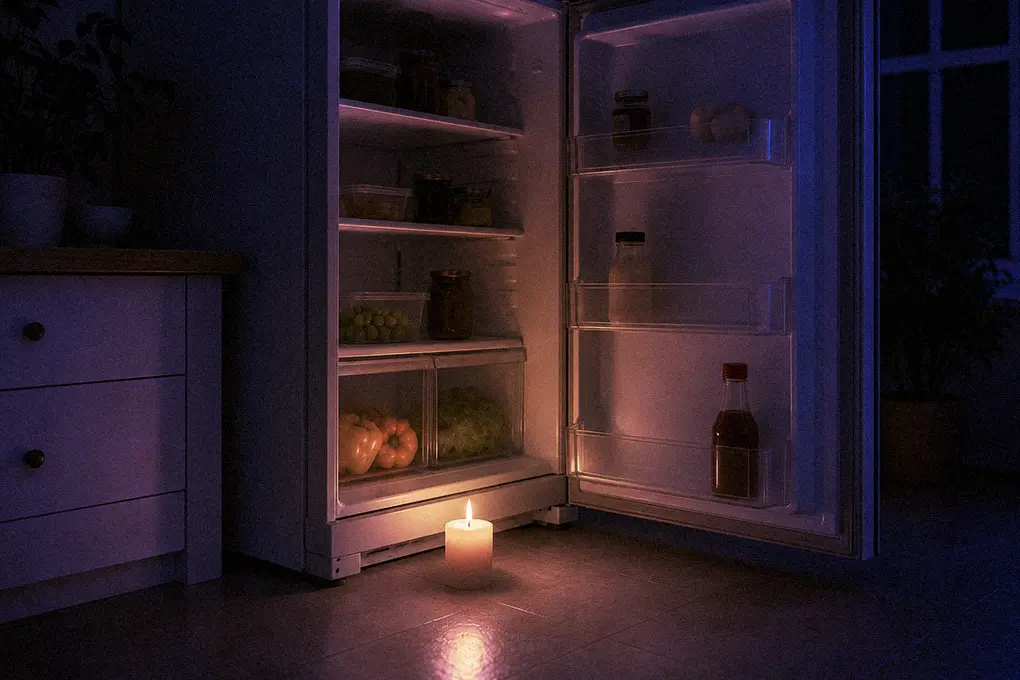
The USDA is blunt about it: once your power goes out, your refrigerator keeps food safe for roughly four hours – and only if you keep the door closed. Your freezer buys you more time, up to 48 hours when full, 24 when half-full. After that, you’re throwing out hundreds of dollars in groceries and hoping no one gets sick.
Power outages in the U.S. have grown significantly more frequent and more prolonged. Grid failures from hurricanes, winter storms, and heat waves now routinely stretch into days rather than hours. That four-hour window isn’t a comfortable buffer – it’s a deadline.
The good news: keeping your refrigerator running during a power outage is one of the most solvable emergency preparedness problems. Two proven options exist – portable power stations (battery-powered, indoor-safe) and gas inverter generators (longer runtime, outdoor-only). Neither is universally better. Matching the right solution to your fridge’s actual wattage, your home setup, and your expected outage duration is what separates a family with cold food from one with a garbage bag full of spoiled groceries.
This guide breaks down refrigerator power requirements, sizes backup options accurately, and recommends the best products across both categories available at Batten’s power generation collection.
Table of Contents
- Key Takeaways
- Refrigerator Wattage: What You Actually Need to Know
- Does a Refrigerator Need Pure Sine Wave Power?
- Option 1: Battery Power Station for Your Refrigerator
- Option 2: Gas Inverter Generator for Refrigerator Backup
- Generator vs. Battery Backup for Refrigerator: Side-by-Side
- Value Comparison: Cost Per Hour of Fridge Runtime
- Protecting Your Refrigerator and Freezer During a Power Outage
- Making the Right Choice for Your Home
- Take the Guesswork Out of Your Fridge Backup Power
- Frequently Asked Questions
- Sources
Key Takeaways
- A refrigerator needs 100-400 running watts and 600-2,000W of startup surge power – always size backup power to the surge, not the running load.
- The USDA confirms food stays safe for only 4 hours in an unpowered fridge (door closed), making emergency power critical in any outage beyond that window.
- Battery power stations are the best backup power supply for a fridge in apartments, suburban homes, and short-to-medium outages – they’re indoor-safe, silent, and instant-on.
- Gas inverter generators deliver multi-day fridge backup but require outdoor use, fuel storage, and regular maintenance; they’re the strongest choice for rural households and extended outages.
- A solar generator pairs panels with a battery station for self-replenishing fridge backup – ideal for households planning for repeated or prolonged grid failures.
- Browse Batten’s portable power stations and generators for verified backup power options sized for refrigerator use.
Refrigerator Wattage: What You Actually Need to Know
Before shopping for any backup power, you need two numbers from your specific refrigerator: running watts and starting (surge) watts.
- Running Watts are the power your fridge draws while the compressor is actively running. Modern energy-efficient refrigerators typically fall between 100-250 watts during operation. Older, larger, or side-by-side models often run 250-400 watts. This is the number printed on most energy labels.
- Starting Watts (also called surge watts) are the brief power spike that occurs every time the compressor kicks on. This surge is 2-3 times the running wattage and can briefly reach 600-2,000+ watts depending on your model. It lasts only a few seconds, but your backup power source must deliver it instantly or the refrigerator simply won’t start.
The starting surge is the number that catches most people off guard. A family that buys a 1,000W power station thinking “my fridge only runs at 150 watts” finds out the hard way when the unit shuts down at compressor startup.
How to Find Your Refrigerator’s Wattage
Check the yellow EnergyGuide label (kWh/year gives you average daily use), the model sticker inside the door frame (lists volts and amps – multiply them for watts), or the manufacturer’s website by model number. A plug-in power meter (Kill-A-Watt style) gives you real-time running watts and shows actual startup surges, which is the most accurate method for sizing backup power.
Refrigerator Wattage by Type
| Refrigerator Type | Running Watts | Startup Surge | Daily kWh |
| Mini / compact | 50-100W | 200-400W | 0.5-1.2 kWh |
| Top-freezer (Energy Star) | 100-200W | 400-800W | 1.0-1.5 kWh |
| Bottom-freezer | 150-250W | 500-1,000W | 1.2-1.8 kWh |
| Side-by-side | 200-400W | 800-1,500W | 1.5-2.5 kWh |
| French door (large) | 250-400W | 1,000-2,000W | 1.8-3.0 kWh |
| Chest freezer | 100-300W | 300-900W | 0.8-2.0 kWh |
Rule of thumb for sizing: Take your fridge’s running watts, triple it for surge, and that’s your minimum backup capacity for starting. For runtime, multiply your fridge’s daily kWh by 0.85 (accounting for inverter efficiency) – that’s how many watt-hours your battery station needs to run it for a full day.
For related guidance on sizing portable power for emergencies, see our Anker SOLIX C1000X power station review and Anker 522 portable power station review.
Does a Refrigerator Need Pure Sine Wave Power?
Yes – and this matters when choosing between a battery station and a generator. Refrigerators use compressor motors that are sensitive to power quality. Pure sine wave output is required for reliable, safe operation. Modified sine wave power can cause compressor motors to run hot, reduce efficiency, or damage the motor over time.
All portable power stations from quality brands (Jackery, EcoFlow, Bluetti, Anker) produce pure sine wave AC output. Gas generators vary: inverter generators produce pure sine wave power, while conventional open-frame generators typically produce modified sine wave – and should not be used to run refrigerators long-term.
Option 1: Battery Power Station for Your Refrigerator
A battery power station (also called a solar generator when paired with panels) is the cleanest, safest, and most apartment-friendly way to run a refrigerator backup power supply. No fumes, no fuel storage, no noise ordinance violations. Plug the fridge directly into the station’s AC outlet and you’re done.
The tradeoff is capacity. Battery stations are finite – once depleted, they need recharging from wall power or solar panels. This makes them well-suited for outages measured in hours or for families who pair them with solar panels for ongoing recharge capability.
For apartments, suburban homes, and families prioritizing indoor safety, a battery power station is the right choice for fridge backup power.
How Long Can a Battery Backup Run a Refrigerator?
Battery runtime depends on capacity (watt-hours) and your fridge’s actual consumption. A modern 150W fridge running at 35% duty cycle consumes roughly 1.25 kWh per day. Here’s how common station sizes stack up:
| Power Station Capacity | Runtime (150W fridge) | Runtime (250W fridge) | Runtime (400W fridge) |
| 1,000 Wh | ~6-7 hours | ~4-5 hours | ~2-3 hours |
| 1,264 Wh | ~8-9 hours | ~5-6 hours | ~3-4 hours |
| 1,536 Wh | ~10-11 hours | ~6-7 hours | ~4-5 hours |
| 5,040 Wh | ~33-36 hours | ~20-25 hours | ~12-15 hours |
Runtime estimates based on 85% inverter efficiency and realistic compressor duty cycle. Actual results vary by fridge model, ambient temperature, and how often the door is opened.
Jackery Solar Generator 1000 Plus: Best Solar-Integrated Fridge Backup
The Jackery Solar Generator 1000 Plus combines the Explorer 1000 Plus power station (1,264Wh, 2,000W output) with SolarSaga panels, making it the strongest value for families who want refrigerator backup that can self-recharge during a multi-day outage.

Jackery Solar Generator 1000 Plus at a Glance
- Capacity: 1,264Wh LiFePO₄
- AC Output: 2,000W continuous / 4,000W surge (handles all residential fridge startups)
- Estimated Fridge Runtime: 8-9 hours (150W fridge); expandable to 5kWh with battery packs
- Recharge: Wall outlet, solar panels (200W input), or car
- Weight: 24 lbs
- Best For: Suburban families wanting solar-capable fridge backup
- Buy: Jackery Solar Generator 1000 Plus at Batten
Pros:
- LiFePO₄ battery rated for 4,000+ cycles (10+ year lifespan)
- 2,000W output handles the startup surge of large side-by-side fridges
- Expandable up to 5kWh with add-on battery packs – extends fridge runtime to 2-3 days
- Solar-ready for multi-day outage scenarios
- Indoor-safe, quiet, no fumes
Cons:
- Base unit runs a standard fridge for roughly 8-9 hours before needing recharge
- Solar charging requires purchased panels and adequate sunlight
- Not ideal for running fridge plus multiple major appliances simultaneously
Jackery Explorer 1500 V2: Best All-Around Portable Power Station for Refrigerator Backup
The Jackery Explorer 1500 V2 is the most cost-effective LFP station in its capacity class, priced at $699 with 1,536Wh capacity and a 2,000W AC output (4,000W surge). It recharges fully in as little as 64 minutes from wall power – meaning if your outage ends and power returns, you can be back to full in about an hour for the next event.

Jackery Explorer 1500 V2 at a Glance
- Price: $699 (as of June 2026)
- Capacity: 1,536Wh LiFePO₄
- AC Output: 2,000W / 4,000W surge
- Estimated Fridge Runtime: 10-11 hours (150W fridge)
- Fast Recharge: 64 minutes (wall outlet)
- Weight: ~38 lbs
- Best For: Families wanting maximum value and fast recharge for repeated outages
- Buy: Jackery Explorer 1500 V2 at Batten
Pros:
- Lowest cost-per-watt-hour in the 1.5kWh LFP class
- 4,000W surge rating comfortably handles even large fridge startups
- 64-minute wall recharge is the fastest in its category
- 6,000 charge cycles (estimated 10-year lifespan)
- 7 output ports run fridge plus lights, phones, and router simultaneously
- Pure sine wave output – safe for compressor motors
Cons:
- At 38 lbs, slightly heavier than some competitors at similar capacity
- Not expandable (fixed capacity, unlike the 1000 Plus)
- Gas generator will always outlast it on multi-day outages without solar
For comparison shopping with other battery station options, see our Bluetti alternatives guide.
Jackery Explorer 5000 Plus: Best for Extended Whole-Home Fridge Backup
When a standard portable station isn’t enough – think week-long outages, running fridge and freezer simultaneously, or households needing to power additional critical appliances – the Jackery Explorer 5000 Plus is in a different category entirely.

Jackery Explorer 5000 Plus at a Glance
- Price: ~$3,499 (as of June 2026)
- Capacity: 5,040Wh LiFePO₄ (expandable to 60kWh)
- AC Output: 7,200W / 14,400W surge; supports 120V and 240V
- Estimated Fridge Runtime: 33-36 hours (150W fridge, base unit)
- Solar Input: Up to 4,000W – full recharge in approximately 2 hours
- UPS Mode: 0ms switchover keeps fridge running without interruption
- Best For: Homeowners, rural households, and anyone needing multi-day self-sufficient backup
- Buy: Jackery Explorer 5000 Plus at Batten
Pros:
- 0ms UPS mode means the fridge never even notices the power went out
- Expandable to 60kWh – enough to run a full refrigerator for weeks with solar
- 7,200W output runs fridge, freezer, lights, and CPAP simultaneously
- 120V/240V dual voltage for broader appliance compatibility
- Smart Transfer Switch (sold separately) enables circuit-level home backup
- Wheeled for mobility, app-controlled
Cons:
- 134 lbs – not portable in the traditional sense (wheeled unit)
- $3,499 entry price is a significant investment
- Requires space for storage
This is the best emergency power source for a refrigerator and freezer running simultaneously during extended grid failures. For similar large-unit comparisons, read our Patriot Power Generator vs. Jackery breakdown.
Option 2: Gas Inverter Generator for Refrigerator Backup
When outages stretch beyond one or two days – hurricanes, winter storms, extended grid failures – a gas inverter generator is the most practical emergency power supply for a refrigerator. Gas-fueled runtime is limited only by your fuel supply, and a single gallon of gasoline can power a refrigerator for many hours.
The critical rules: generators must always run outdoors, at least 20 feet from any door or window. Carbon monoxide poisoning kills. Never run a generator in a garage, even with the door open. An extension cord rated for outdoor use connects the fridge to the generator.
For anyone considering whole-home standby options, our best natural gas home generator guide covers permanently installed units that activate automatically during outages.
What Size Generator to Run a Refrigerator?
Sizing a generator for a refrigerator means matching the generator’s starting watt capacity to your fridge’s startup surge – not just its running load.
- Minimum: 1,500-2,000 running watts with 2,000-3,000W starting watts covers most modern Energy Star refrigerators.
- Recommended for fridge + freezer + lights: 3,000-4,000 running watts.
- For larger side-by-side fridges, older models, or running multiple appliances: 5,000+ watts.
A 2,000W inverter generator can run a standard refrigerator and leave headroom for lights, phone charging, and a fan. That’s the sweet spot for families who want a quiet, fuel-efficient solution for power outage refrigerator backup. Our DuroMax XP10000E review covers what higher-wattage options look like for whole-home coverage.
Honda EU2200i: Best Inverter Generator for Refrigerator Backup
The Honda EU2200i is widely regarded as the benchmark quiet inverter generator for emergency home use. At 48-57 dBA, it operates at conversation-level noise – a massive advantage over conventional open-frame generators. Its 2,200W peak / 1,800W rated output covers the vast majority of residential refrigerators with room to spare.

Honda EU2200i at a Glance
- Running Watts: 1,800W rated
- Starting Watts: 2,200W peak
- Fuel Tank: 0.95 gallons
- Runtime: 3.2-8.1 hours per tank (load-dependent)
- Noise Level: 48-57 dBA (quieter than a normal conversation)
- Weight: 47.4 lbs
- CO Safety: Built-in CO-MINDER™ auto-shutoff
- Best For: Families in suburban or semi-rural areas needing quiet multi-day fridge backup
- Buy: Honda EU2200i at Batten
Pros:
- Pure sine wave inverter – safe for sensitive refrigerator electronics and compressors
- Eco-Throttle adjusts engine speed to load, maximizing fuel efficiency
- Two EU2200i units can be paralleled for 4,400W when needed
- CO-MINDER shuts down automatically if carbon monoxide reaches dangerous levels
- Honda’s commercial-grade GXR120 engine is among the most reliable in the category
- 3-year residential warranty
Cons:
- Gas-powered: outdoor use only, requires fuel storage and maintenance
- 2,200W peak means large French-door fridges with 1,500W+ startup surges consume most of the capacity
- Can’t run a full-size central AC or electric range simultaneously
- Long-term fuel costs add up during extended outages
Fuel Planning for the EU2200i: At moderate load (running fridge + lights), expect roughly 5-6 hours per tank. For a 72-hour outage, plan for approximately 3-4 gallons of stabilized gasoline.
Generator vs. Battery Backup for Refrigerator: Side-by-Side
| Feature | Battery Power Station | Gas Inverter Generator |
| Indoor Safe | ✅ Yes | ❌ No (outdoor only) |
| Noise | Silent | 48-65+ dBA |
| Startup Time | Instant | Manual pull/start |
| Runtime Limit | Battery capacity only | Unlimited (with fuel) |
| Fuel / Recharge | Wall power, solar | Gasoline (storage required) |
| Outage Duration Sweet Spot | 4-24 hours | 24 hours to several days |
| Pure Sine Wave | Always | Inverter models only |
| Maintenance | None | Oil changes, fuel stabilizer |
| Best Scenario | Apartments, suburbs, short outages | Rural, extended outages |
| Entry Cost | $699-$3,499+ | $1,000-$2,000+ |
The interpretation: Battery stations win on convenience, safety, and speed. Gas generators win on extended runtime and fuel availability. For most suburban families, a 1,500Wh battery station handles 90% of outage situations. Rural households and anyone facing multi-day events should have a gas generator – or pair a battery station with solar for a self-replenishing setup.
Value Comparison: Cost Per Hour of Fridge Runtime
| Product | Price | Fridge Runtime (150W model) | Cost Per Hour |
| Jackery Solar Generator 1000 Plus | $999 (with panels) | 8-9 hours base + solar recharge | ~$0.01/hr ongoing |
| Jackery Explorer 1500 V2 | $699 | 10-11 hours per charge | ~$0.063/hr per charge |
| Honda EU2200i | ~$1,099 | Unlimited (fuel cost) | ~$0.25-$0.50/hr (fuel) |
| Jackery Explorer 5000 Plus | $3,499 | 33-36 hours base + expandable | ~$0.009/hr with solar |
Solar-paired units approach near-zero ongoing fuel cost with adequate sun exposure. Gas generator costs assume $3.50/gallon and 5-6 hours runtime per 0.95-gallon tank.
The 1000 Plus Solar Generator offers the best long-term value for families planning around repeated outages – solar recharge makes each subsequent outage essentially free. The EU2200i’s higher ongoing fuel cost is justified by unlimited runtime and the ability to run through weeks-long grid failures.
Protecting Your Refrigerator and Freezer During a Power Outage
Even with backup power ready, knowing how to manage your fridge and freezer during an outage reduces food waste and keeps your family safe:
- Keep the doors closed. Every opening releases cold air and shortens your safe window. Refrigerators stay safe for 4 hours (USDA); full freezers for 48 hours.
- Pre-cool before outages. When severe weather approaches, lower your fridge to 35°F and freezer to 0°F to extend safe food storage time.
- Use a backup power source immediately for outages expected to exceed 2-3 hours – don’t wait until food is at risk.
- Keep a thermometer inside your fridge and freezer. When power returns, check actual temperature before eating anything. Discard perishables that exceeded 40°F for more than 2 hours.
- Run the fridge, not the freezer. Freezers hold temperature far longer. Prioritize your fridge backup power connection first.
- Consolidate food. A packed fridge holds temperature better than a half-empty one.
For more on managing food safety and power during extended outages, see our emergency communication and power loss guide.
Making the Right Choice for Your Home
Battery station or gas generator – the decision comes down to your living situation, likely outage duration, and household needs:
Choose a battery power station if:
- You live in an apartment or can’t run a generator outdoors safely
- Your typical outages are under 24 hours
- You want silent, maintenance-free backup that’s ready instantly
- You plan to add solar panels for extended recharge capability
Choose a gas inverter generator if:
- You have outdoor space and safe storage for gasoline
- You live in a rural area with longer typical outage durations
- You need to run fridge, freezer, and additional appliances simultaneously
- You want backup power that extends indefinitely with fuel resupply
Choose both if you’re serious about preparedness. A battery station handles immediate outages silently indoors; a generator covers extended events. The Jackery 1000 Plus Solar Generator and Honda EU2200i pair naturally as a complete fridge backup system.
For households evaluating larger backup power upgrades, our Anker 522 review and Bluetti alternatives guide provide additional context on the broader market.
Take the Guesswork Out of Your Fridge Backup Power
Don’t wait for a power outage to find out your backup solution isn’t sized right. Browse Batten’s complete power generation collection for portable power stations, solar generators, and inverter generators sized for refrigerator backup – all verified for real-world emergency use.
Frequently Asked Questions
Can a Portable Power Station Run a Refrigerator?
Yes, as long as the station’s AC output meets or exceeds the refrigerator’s startup surge watts. Look for at least 1,500W output (2,000W+ recommended) with a surge rating above your fridge’s startup wattage. Models like the Jackery 1500 V2 (2,000W / 4,000W surge) reliably start and run standard residential refrigerators.
What Size Generator Do I Need to Run a Refrigerator?
A 2,000W inverter generator handles most modern Energy Star refrigerators. If you’re running a large side-by-side, French-door model, or want to power fridge plus freezer simultaneously, step up to a 3,000-4,500W unit. Always confirm your fridge’s startup surge watts before purchasing.
How Long Can a Battery Backup Run a Refrigerator?
It depends on capacity and fridge draw. A 1,536Wh station like the Jackery 1500 V2 runs a 150W refrigerator for roughly 10-11 hours. A 5,040Wh unit like the Jackery Explorer 5000 Plus extends that to 33-36 hours. Adding solar panels allows continuous recharging, eliminating the time limit entirely on sunny days.
How Many Watts Does a Refrigerator Use?
Modern refrigerators use 100-400 running watts depending on size and efficiency. The compressor startup surge temporarily draws 2-3× more – often 600-2,000W for 1-3 seconds. Check your model’s EnergyGuide label or measure with a plug-in watt meter for exact numbers.
Can a Solar Generator Power a Refrigerator?
Yes. A solar generator combines a battery power station with solar panels, allowing ongoing recharging during daylight. The Jackery Solar Generator 1000 Plus with 200W+ of panels can sustain a standard refrigerator indefinitely during sunny conditions, making it effective for multi-day outages.
Will a 1,000 Watt Generator Run a Refrigerator?
It depends on the refrigerator’s startup surge. A 1,000W generator may handle a small, efficient mini-fridge (200-400W surge), but will struggle to start most full-size refrigerators with 600-1,500W surges. A 2,000W generator is the minimum recommended for standard residential fridges.
Do Refrigerators Need Pure Sine Wave Power?
Yes. Refrigerator compressor motors are sensitive to power quality. Modified sine wave power from conventional open-frame generators can cause motor overheating and compressor damage over time. All quality portable power stations and inverter generators (including the Honda EU2200i) produce pure sine wave output.
What Is the Best Way to Power a Refrigerator During a Blackout?
For short outages (under 12 hours): a 1,500Wh+ portable battery station. For multi-day outages: a 2,000W+ gas inverter generator. For repeated or extended events: a solar generator pairing a large battery station with solar panels for self-replenishing power.
Sources
- “Food Safety During Power Outage,” 2024, FoodSafety.gov, https://www.foodsafety.gov/food-safety-charts/food-safety-during-power-outage
- “Food and Water Safety During Power Outages and Floods,” U.S. Food & Drug Administration, https://www.fda.gov/food/buy-store-serve-safe-food/food-and-water-safety-during-power-outages-and-floods
- “Keep Food Safe After a Disaster or Emergency,” Centers for Disease Control and Prevention, 2025, https://www.cdc.gov/food-safety/foods/keep-food-safe-after-emergency.html
- “Keep Your Food Safe During Emergencies,” USDA Food Safety and Inspection Service, https://www.fsis.usda.gov/food-safety/safe-food-handling-and-preparation/emergencies/keep-your-food-safe-during-emergencies
- “How Many Watts Does a Refrigerator Use? Complete Guide,” Anker SOLIX, 2025, https://www.ankersolix.com/blogs/home-power-backup/how-many-watts-does-a-refrigerator-use-get-acquainted-now
- “Refrigerator Wattage and Amperage: How Much Power Does Your Fridge Use,” Wilprepkitchen.com, February 2025, https://wilprepkitchen.com/blogs/topic/refrigerator-wattage-and-amperage-how-much-power-does-your-fridge-use
- “EU2200i Super Quiet Inverter Generator Specifications,” Honda Power Equipment, https://powerequipment.honda.com/generators/models/eu2200i
- “Jackery Explorer 1500v2 Launch Press Release,” GlobeNewswire, November 2025, https://finance.yahoo.com/news/jackery-unveils-explorer-1500v2-smallest-234300016.html